Private Pilot Licence - Aeroplane
Demo: PPL/A
Real exam questions to try for free — no registration needed.
What is the best combination of traits for a pilot's individual attitude and behaviour?
Show solution
The best combination is 'Extroverted - stable' because a stable, extroverted pilot communicates well, remains calm, and acts appropriately under stress. The other options involve instability or poor communication, which can make flying less safe.
Complacency is a risk due to...
Show solution
The correct answer is 'increased cockpit automation' because automation can make pilots less vigilant. The other options are incorrect as they do not directly cause complacency but refer to other issues or benefits.
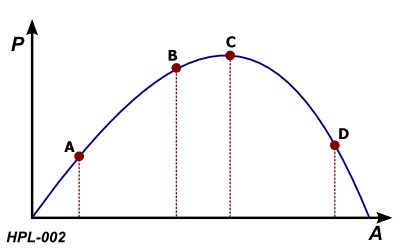
The ideal level of arousal is at which point in the diagram? See figure (HPL- 002) P = Performance A = Arousal / Stress
Show solution
The ideal level of arousal is at Point B, where performance is highest. Point A shows too little arousal (low performance), Points C and D show too much arousal (performance drops). Only at Point B is the balance optimal.
At which point in the diagram will a pilot find himself to be overstrained? See figure (HPL-002) P = Performance A = Arousal / Stress
Show solution
At Point D, performance drops sharply due to excessive stress—this is where the pilot is overstrained. Points A, B, and C are in the range of optimal or increasing performance, not overstrain.
Which of the following properties are influenced by stress? 1. Attention 2. Concentration 3. Responsiveness 4. Memory
Show solution
The correct answer is: Attention, concentration, responsiveness, and memory are all influenced by stress. Stress affects many mental abilities. The other answers are incorrect because they do not include all affected properties.
During flight a problem occurs which you must solve; how do you proceed?
Show solution
The correct answer is to keep flying and stabilizing the aircraft first, then solve the problem while continuing to fly. The other options are wrong because flying always has priority; you must not neglect control to solve problems or ignore them.
What is the gas composition of "air"?
Show solution
Dry air is about 78% nitrogen, 21% oxygen, and 1% noble gases/carbon dioxide. The other answers are incorrect because they swap nitrogen and oxygen or wrongly list water vapor as a main component.
What is the mean height of the tropopause according to ISA (ICAO Standard Atmosphere)?
Show solution
The mean height of the tropopause according to ISA is 11,000 m. 11,000 ft and 18,000 ft are too low, and 36,000 m is much too high. The standard atmosphere defines 11,000 m as the average tropopause height.
Which unit is used for temperatures given by meteorological aviation services in Europe and Africa?
Show solution
The correct answer is Degrees Centigrade (°C), as temperatures in aviation meteorology in Europe and Africa are always given in Celsius. Kelvin and Fahrenheit are not used, and Gpdam is not a temperature unit.
The temperature lapse rate with increasing height within the troposphere according ISA is...
Show solution
The correct answer is 0.65°C per 100 m, as this is the standard lapse rate in the troposphere according to ISA. 3°C, 0.6°C, and 1°C per 100 m are either too high or too low and do not match the standard value.
What is the ISA standard pressure at FL 180 (5500 m)?
Show solution
The correct answer is 500 hPa, as the standard pressure at FL 180 according to ISA is about 500 hPa. 1013.25 hPa is sea level pressure, 250 hPa and 300 hPa are for much higher flight levels.
The altimeter can be checked on the ground by setting...
Show solution
Correct: Set QNH and compare the indication with the airfield elevation. QNH gives elevation above sea level. QNE uses standard pressure, QFE shows height above the airfield, and QFF is not used for this check.
Given the following information, what is the true altitude? (rounded to the nearest 50 ft) QNH: 983 hPa Altitude: FL 85 Outside Air Temperature: ISA - 10°
Show solution
The true altitude is 7,300 ft because with a low QNH and temperature below ISA, the true altitude is lower than the flight level. The other values are too high and do not account for the corrections properly.
Above the friction layer, with a prevailing pressure gradient, the wind direction is...
Show solution
Above the friction layer, wind blows parallel to the isobars because friction is minimal. The other options are incorrect: wind is not perpendicular to isobars or isohypses, nor does it blow at a 30° angle to the isobars, but parallel.
Which of the stated surfaces will reduce the wind speed most due to ground friction?
Show solution
Mountainous areas with vegetation reduce wind speed the most because both terrain and plants increase friction. Flat land with vegetation, deserts, and oceans offer less resistance as they have fewer obstacles for the wind.
When air masses meet each other head on, how is this referred to and what air movements will follow?
Show solution
When air masses meet head on, this is called convergence, which causes air to rise. The other options are incorrect because divergence means air spreads apart, and sinking air is linked to divergence, not convergence.
What are the air masses that Central Europe is mainly influenced by?
Show solution
Central Europe is mainly influenced by polar cold air and tropical warm air, as these air masses shape the climate. Arctic, equatorial, or only tropical air masses rarely or never reach Central Europe.
With regard to global circulation within the atmosphere, where does polar cold air meets subtropical warm air?
Show solution
Polar cold air meets subtropical warm air at the polar front. The other options are incorrect because these air masses do not meet at the geographic poles, the equator, or the subtropical high pressure belt.
"Foehn" conditions usually develop with...
Show solution
Foehn develops when stable air is widely blown against a mountain ridge. The air rises, cools, loses moisture, and descends warm and dry. The other options are incorrect because they mention instability or lack of airflow, which do not create Foehn.
Light turbulence always has to be expected...
Show solution
Light turbulence is expected below cumulus clouds due to rising warm air (thermal convection). Above cumulus clouds, air is calmer. Inversions and stratiform clouds in medium layers usually do not cause such turbulence.
Moderate to severe turbulence has to be expected...
Show solution
Moderate to severe turbulence occurs on the lee side of a mountain range when rotor clouds are present, as strong air currents form there. The windward side, low stratus clouds, or unbroken cloud layers usually do not cause such turbulence.
Which answer contains every state of water found in the atmosphere?
Show solution
Water exists in the atmosphere as liquid (rain), solid (snow, hail), and gaseous (water vapor). The other answers miss at least one state, so only 'liquid, solid, and gaseous' is correct.
How do spread and relative humidity change with increasing temperature?
Show solution
As temperature increases, the spread (difference between temperature and dew point) increases because temperature rises faster than dew point. Relative humidity decreases since warmer air can hold more moisture, but the actual water vapor stays the same.
The "spread" is defined as...
Show solution
The 'spread' is the difference between actual temperature and dew point. It indicates how close the air is to saturation. The other options describe ratios, other differences, or the maximum water vapor, which are incorrect.
The saturated adiabatic lapse rate is...
Show solution
The saturated adiabatic lapse rate is lower than the dry adiabatic lapse rate because condensation releases heat, slowing the cooling. The other options are incorrect: it is never equal to, proportional to, or higher than the dry adiabatic lapse rate.