Private Pilot Licence - Helicopter
Demo: PPL/H
Real exam questions to try for free — no registration needed.
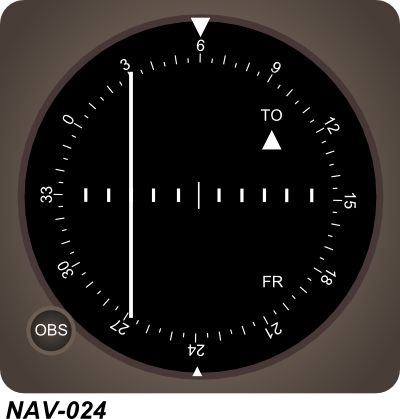
The aircraft is on radial: See annex (NAV-024)
Show solution
The aircraft is on radial 234 because radials are measured from the station outward. The other options (246, 060, 066) represent different directions that do not match the aircraft's indicated position.
The range of a VOR is affected by...
Show solution
The range of a VOR depends on the altitude of the transmitter and receiver, as VORs operate on line-of-sight. Daylight interference, ground wave multipath, and reflected sky waves do not significantly affect VOR range.
The distance measuring equipment (DME) determines the distance based on the principle of...
Show solution
DME measures distance by timing how long a radio signal takes to travel to the ground station and back. Phase comparison, laser measurement, and Doppler are not used in DME.
The DME reading is a...
Show solution
DME shows the slant range, which is the direct line distance between aircraft and ground station. Ground distance is incorrect as it ignores altitude. GNSS distance and radial distance are different measurements and not what DME displays.
What is the difference between primary and secondary radar?
Show solution
Correct: Primary radar pulses are reflected by the aircraft, secondary radar pulses are answered by a transponder. The other options incorrectly describe modulation types or display methods, not the actual operational difference.
The transponder code in case of a radio communication failure is...
Show solution
The transponder code 7600 indicates radio communication failure. 7000 is for VFR flights, 7500 signals hijacking, and 7700 is for emergencies. Only 7600 is used for lost radio contact.
Which component of pilot competence primarily involves understanding aviation principles, regulations, procedures, and operational aspects of aircraft?
Show solution
'Knowledge' is correct because understanding aviation principles, regulations, and procedures is part of knowledge. 'Skills' are about practical execution, 'Attitudes' are about mindset, and 'Experience' is about accumulated practice.