Sailplane Pilot Licence
Demo: SPL
Real exam questions to try for free — no registration needed.
An off-field landing with tailwind is inevitable. How should the landing be conducted?
Show solution
Correct: Approach with normal speed, expect longer flare and ground roll. Tailwind increases landing distance. Reduced speed is unsafe, increased speed or not using spoilers is incorrect.
When landing with tailwind, the pilot has to...
Show solution
The correct answer is: approach with normal speed and shallow angle. This is right because a shallow approach helps manage the longer landing roll caused by tailwind. The other options are incorrect as they are unsafe or not standard procedure.
When a pilot gets into a strong downwind area during slope soaring, what action should be recommanded?
Show solution
The correct action is to increase speed and head away from the ridge. This helps to quickly leave the dangerous downdraft area. Getting closer to the ridge or landing parallel increases risk. Continuing flight is unsafe, as downdrafts can be strong and persistent.
A plane flying below an extended Cumulus cloud developing into a thunderstorm, the glider plane quickly approaches the cloud base. What actions have to be taken by the glider pilot?
Show solution
The correct action is to extend spoiler flaps within speed limits and leave the thermal lift area at maximum permissible speed. This prevents entering the dangerous thunderstorm cloud. The other options increase risk due to turbulence, lightning, or loss of control.
After landing, you realize you lost your pen which might have fallen down in the cockpit of the sailplane. What has to be considered?
Show solution
Before the next take-off, the cockpit must be thoroughly checked for loose objects, as even small items like a pen can block controls. The other answers are wrong because they underestimate the risk or do not require a proper check.
During approach for landing with strong crosswind, how should the turn from base to final be flown?
Show solution
Correct: Turn with max 30° bank, watch speed and yaw string, correct track after overshoot. This ensures control and safety. 60° bank is too steep and risky. Early alignment with rudder can cause dangerous skidding.
What heights should be consideres for landing phases with a glider plane?
Show solution
Heights of 150-200 m abeam threshold and 100 m after final approach turn are standard for glider landings, giving enough safety and time for corrections. The other options are either too low or too high and do not match standard procedures.
After reaching what height during winch launch the maximum pitch position can be taken?
Show solution
The maximum pitch position can be taken from approx. 50 m, provided the safe winch launch speed is maintained. Earlier would be unsafe in case of cable break. The other answers are incorrect as they suggest too early, too late, or incorrect conditions.
What has to be checked before any change in direction during glide?
Show solution
Before changing direction, you must check if the airspace in the desired direction is clear to avoid collisions. Thermal clouds, loose objects, or coordinated turns are less critical than collision avoidance.
Before a winch launch, you detect a light tailwind. What has to be considered?
Show solution
With a tailwind, the roll until lift-off takes longer because the wind increases the take-off distance. Speed must be monitored carefully. The other answers are wrong: tailwind does not help, a weaker brake point is unsafe, and pulling full elevator after lift-off is dangerous.
Exceeding the maximum allowed aircraft mass...
Show solution
Exceeding the maximum allowed aircraft mass is not permissible and is essentially dangerous, as it seriously affects performance and safety. The other options are incorrect because they suggest exceptions or compensation, which are not allowed by regulations.
The term "center of gravity" is defined as...
Show solution
The center of gravity is the point at which the total mass of the aircraft is considered to act. The other options are incorrect: it's not just the heaviest point, not the neutral point, and not halfway between the neutral point and datum line.
The term "moment" with regard to a mass and balance calculation is referred to as...
Show solution
The moment is the product of a mass and a balance arm. Only this gives the turning effect about a point. The sum, difference, or quotient of mass and arm do not represent a physical moment.
The balance arm is the horizontal distance between...
Show solution
The balance arm is the horizontal distance between the C.G. of a mass and the datum line. The other options are incorrect because they refer to limits or compare the C.G. to a limit, not to the datum, which is the reference point.
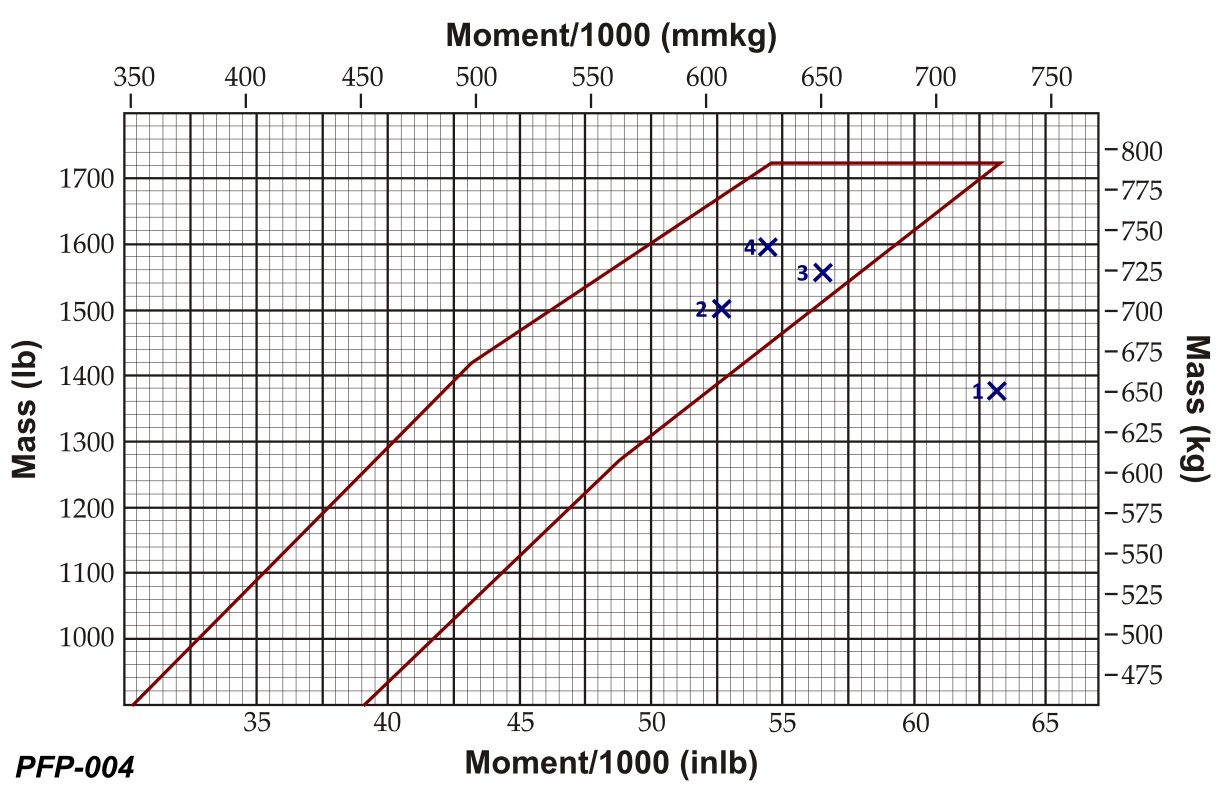
For the purpose of a flight preparation the pilot calculates a total take-off mass of 725 kg and a total moment of 650 mmkg. Which cross marks the center of gravity (CG)? See annex (PFP-004)
Show solution
The correct cross is at the intersection of 725 kg (mass) and 650,000 mmkg (moment). Only this cross shows the correct center of gravity. The other crosses are at different mass or moment values and are therefore incorrect.
Which factor shortens landing distance?
Show solution
A strong head wind shortens landing distance by reducing groundspeed at touchdown. High density altitude, high pressure altitude, and heavy rain all increase landing distance by reducing braking effectiveness or aircraft performance.
The angle of descent is defined as...
Show solution
Correct: The angle of descent is the angle between a horizontal plane and the actual flight path, expressed in degrees. The other answers confuse angles with percentages or describe a ratio, not the angle itself.
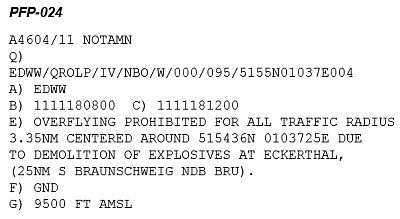
Up to which altitude is an overflight prohibited according to the NOTAM? See figure (PFP-024)
Show solution
The correct answer is 'Altitude 9500 ft MSL' because the NOTAM specifies the altitude in feet above mean sea level (MSL). The other options are incorrect as they refer to meters, flight level, or height above ground, which do not apply here.
What must be considered for cross-border flights?
Show solution
For cross-border flights, filing a flight plan is required so authorities are informed. The other options are not generally mandatory or relate to different situations.
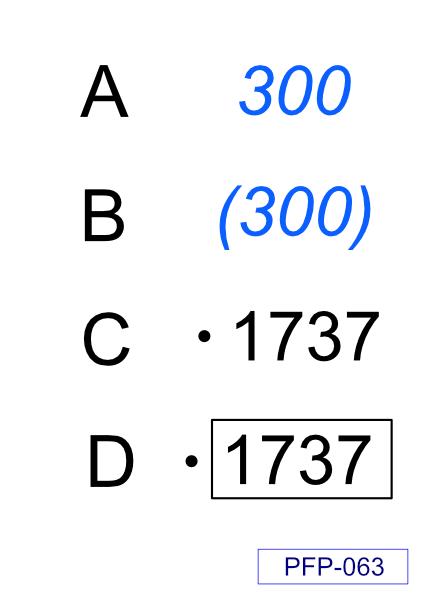
(For this question, please use annex PFP-063) According ICAO, what symbol indicates a general spot elevation?
Show solution
The correct symbol for a general spot elevation according to ICAO is symbol C. This symbol shows a small number with a dot below it. The other symbols represent different map features and not spot elevations.
Which levers in a glider's cockpit are indicated by the colors red, blue and green? Levers for usage of...
Show solution
The levers for cabin hood release (red), air brakes (blue), and elevator trim (green) are always marked with these colors. Other options are incorrect because gear or cable release have different colors or are not always present.
The thickness of the wing is defined as the distance between the lower and the upper side of the wing at the...
Show solution
The thickness of the wing is defined as the distance between the lower and upper side at the thickest part of the wing. Only here is the maximum thickness measured. The other options are incorrect because they refer to thinner, inner, or outer parts, not the maximum thickness.
What is a tubular steel construction with a non self-supporting skin referred to as?
Show solution
A tubular steel construction with a non self-supporting skin is called grid construction, as the tubes carry the loads and the skin is only a cover. The other types refer to structures where the skin is load-bearing.
Primary fuselage structures of wood or metal planes are usually made up by what components?
Show solution
Fuselage structures are mainly made of frames and stringers. Frames give shape and strength across, stringers run lengthwise. Girders, ribs, and covers are not the main fuselage elements; ribs are for wings, covers are not structural.
A construction made of frames and stringer with a supporting skin is called...
Show solution
Semi-monocoque construction uses frames and stringers with a load-bearing skin. Grid construction lacks a supporting skin, wood- or mixed construction refers only to materials, and honeycomb structure is a special lightweight design, not the described type.