Balloon Pilot Licence - Gas Balloon
Demo: BPL/G
Real exam questions to try for free — no registration needed.
In case of damage of the hull of a gas ballon, repairs have to be done by a certified Approved Aeronautical Workshop when exceeding a length of:
Show solution
The correct answer is 1.0 m, as tears longer than 1.0 m must be repaired by an approved aeronautical workshop. Shorter tears can be repaired by the owner. 0.5 m, 2.0 m, and 5.0 m are either too short or too long and do not match the regulations.
Damages at the basket ropes have to be fixed by:
Show solution
Damages at the basket ropes must be fixed by an Approved Aeronautical Workshop, as this ensures safety and compliance. The pilot or temporary fixes are not allowed, and waiting until the next inspection is unsafe.
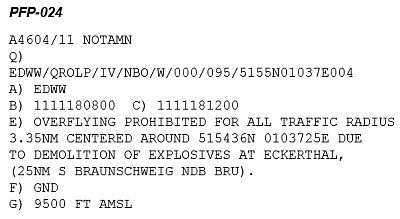
Up to which altitude is an overflight prohibited according to the NOTAM? See figure (PFP-024)
Show solution
The correct answer is 'Altitude 9500 ft MSL' because the NOTAM specifies the altitude in feet above mean sea level (MSL). The other options are incorrect as they refer to meters, flight level, or height above ground, which do not apply here.
What must be considered for cross-border flights?
Show solution
For cross-border flights, filing a flight plan is required so authorities are informed. The other options are not generally mandatory or relate to different situations.
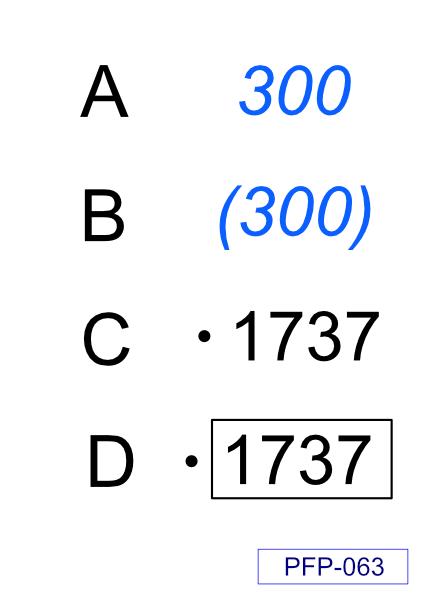
(For this question, please use annex PFP-063) According ICAO, what symbol indicates a general spot elevation?
Show solution
The correct symbol for a general spot elevation according to ICAO is symbol C. This symbol shows a small number with a dot below it. The other symbols represent different map features and not spot elevations.
QFE is the...
Show solution
QFE is the barometric pressure at a reference datum, typically the runway threshold. The other options refer to sea level pressure, altitude above 1013.25 hPa, or magnetic bearing, which do not define QFE.
Which is the purpose of the altimeter subscale?
Show solution
The altimeter subscale is used to reference the altimeter reading to a specific pressure level, such as mean sea level, aerodrome level, or standard pressure (1013.25 hPa). The other options are incorrect because the subscale does not adjust for temperature or system errors.
In which way may an altimeter subscale which is set to an incorrect QNH lead to an incorrect altimeter reading?
Show solution
If the subscale is set to a higher than actual pressure, the altimeter shows too high. The aircraft is closer to the ground than indicated. The other answers confuse the effect or describe the opposite situation.
Lower-than-standard temperature may lead to...
Show solution
A lower-than-standard temperature causes the altimeter to indicate too high. This is because denser air makes the altimeter overread. The other options are incorrect: they either state the opposite, suggest perfect correction, or confuse with Pitot tube issues, which do not affect the altimeter.
A true altitude is...
Show solution
True altitude is an altitude above mean sea level corrected for non-standard temperature and QNH. This gives the actual height above sea level. The other options refer only to ground level, pressure, or temperature, which is incorrect.
The measurement of altitude is based on the change of the...
Show solution
Altitude measurement is based on static pressure, which decreases as altitude increases. Total, dynamic, and differential pressures are used for other instruments like the airspeed indicator, not the altimeter.
Which of the following options states the working principle of a vertical speed indicator?
Show solution
Correct: The vertical speed indicator measures the rate of change of static pressure by comparing current static pressure with that inside a reservoir. The other options are incorrect: they mention total pressure, vacuum, or acceleration, which are not how the instrument works.
The vertical speed indicator measures the difference of pressure between...
Show solution
The vertical speed indicator measures the difference between the present static pressure and the static pressure of a previous moment. This shows climb or descent rate. The other options are incorrect because they refer to dynamic or total pressure, which are not used by the VSI.
The term "static pressure" is defined as pressure...
Show solution
Static pressure is the pressure of undisturbed airflow, meaning the ambient air pressure unaffected by movement. Cabin pressure is unrelated. Pressure from orderly flow is dynamic pressure. The pitot tube measures total, not just static, pressure.
The altimeter's reference scale is set to airfield pressure (QFE). What indication is shown during the flight?
Show solution
With the altimeter set to QFE, it shows height above the airfield. The other options are incorrect: they refer to elevation above sea level, pressure altitude, or the airfield's elevation, not the height above the airfield.
A vertical speed indicator connected to a too big equalizing tank results in...
Show solution
A too big equalizing tank causes the vertical speed indicator to show too high values, as the larger volume amplifies pressure changes. The other options are wrong: the instrument still works, is not overloaded, and does not show too low values.
A vertical speed indicator measures the difference between...
Show solution
Correct: The VSI measures the difference between instantaneous static pressure and previous static pressure, indicating vertical speed. The other options mention total or dynamic pressure, which are not used by the VSI.
Which parts of a balloon provide protection for the basket during landing?
Show solution
Wearing strips protect the basket during landing as they are attached to the bottom and absorb impact. Rubber pads, steel runners, and wheels are not used on balloons and do not protect the basket.
The purpose of the drag lines of the parachute is...
Show solution
The drag lines transfer the force from the pull rope to the parachute, allowing it to open when pulled. The other answers are incorrect because they describe wrong functions or refer to other balloon parts.
Which gas is heavier than air?
Show solution
Propane is heavier than air because its density is higher. Helium and hydrogen are much lighter than air. Illuminating gas is usually a mixture that is also lighter than air. Therefore, only propane is heavier than air.
Which of the gases stated below is NOT made up from hydrocarbons?
Show solution
Hydrogen contains no carbon atoms, only hydrogen atoms. Methane, propane, and butane are hydrocarbons because they are made of both carbon and hydrogen atoms.
The towing cord of a gas balloon can be found on...
Show solution
The towing cord of a gas balloon is on the rip panel side, as this allows for quick deflation in emergencies. The sandpourer, sliding, and entry sides are not related to the towing cord's function.
The density of helium gas under standard conditions is:
Show solution
The correct answer is 0.2 kg/m³, as helium's density under standard conditions is about 0.1785 kg/m³. 2 kg/m³ and 0.2 g/m³ are much too high or too low, and 0.02 g/m³ is also too low. Only 0.2 kg/m³ is close to the correct value.
What is the purpose of the appendix-pull close rope of a gas balloon?
Show solution
The appendix-pull close rope is used to close the filling nozzle (appendix) of a gas balloon, preventing gas from escaping. It does not close the sand disposer, secure the trail rope, or close the emergency opening.
The emergency release of a gas balloon is located where?
Show solution
The emergency release is located beside the filling nozzle, allowing quick gas release in emergencies. The other options (upper pole, equator, side of the valve) are not used for emergency openings.