Private Pilot Licence - Aeroplane
Demo: PPL/A
Real exam questions to try for free — no registration needed.
How do induced drag and parasite drag change with increasing airspeed during a horizontal and stable cruise flight?
Show solution
As speed increases, induced drag decreases because less lift per speed unit is needed. Parasite drag increases since air resistance rises with speed. The other answers are incorrect as they describe the opposite or both decreasing/increasing, which is not correct.
Which statement about induced drag during the horizontal cruise flight is correct?
Show solution
The correct answer is: Induced drag decreases with increasing airspeed. This is because at higher speeds, less angle of attack is needed, reducing induced drag. The other options are incorrect as they either state the opposite or suggest a minimum or maximum that does not exist in this context.
In case of a stall it is important to...
Show solution
The correct answer is: decrease the angle of attack and increase the speed. This recovers from a stall. The other options are wrong because increasing the angle of attack or reducing speed would worsen or prolong the stall.
Which statement regarding a spin is correct?
Show solution
During spin recovery, ailerons should be kept neutral to avoid worsening the spin. Speed does not constantly increase during a spin, all aircraft can spin, and crossing ailerons is incorrect.
What changes upon flaps deployment?
Show solution
Deploying flaps changes the trim condition, as lift and pitching moment are affected. The effectiveness of the ailerons, the center of gravity position, and the engine's twist effect are not directly changed by flap deployment.
The laminar boundary layer on the aerofoil is located between...
Show solution
The laminar boundary layer starts at the stagnation point and ends at the transition point, where it becomes turbulent. Other options are incorrect because they mention the wrong start or end points, or use terms like center of pressure, which are not relevant here.
What structural item provides lateral stability to an airplane?
Show solution
Wing dihedral provides lateral stability, as it helps the aircraft return to level after a roll. The vertical tail and elevator affect directional and longitudinal stability, not lateral. Differential aileron deflection is for roll control, not stability.
"Longitudinal stability" is referred to as stability around which axis?
Show solution
Longitudinal stability refers to stability around the lateral axis, which controls pitch. The vertical axis is for yaw, the longitudinal axis is for roll, and the propeller axis is not relevant for stability types.
Stability around which axis is mainly influenced by the center of gravity's longitudinal position?
Show solution
Stability around the lateral axis (pitch axis) is mainly influenced by the longitudinal center of gravity. If the CG is too far forward or aft, the aircraft becomes unstable in pitch. The longitudinal, vertical, and gravity axes are less affected.
The elevator moves an aeroplane around the...
Show solution
The elevator moves the aircraft around the lateral axis, causing the nose to pitch up or down. The vertical and longitudinal axes are controlled by other control surfaces, not the elevator. There is no 'elevator axis.'
Deflecting the rudder to the left causes...
Show solution
Deflecting the rudder to the left causes yawing of the aircraft to the left, as the rudder pushes the tail right and the nose left. The other answers are incorrect because they refer to the wrong direction or to pitching, which is controlled by the elevator, not the rudder.
What is the advantage of differential aileron movement?
Show solution
The advantage of differential aileron movement is that the drag of the downwards deflected aileron is reduced, making adverse yaw smaller. The other answers are incorrect because they either increase adverse yaw or are unrelated to aileron deflection effects.
Which design feature can compensate for adverse yaw?
Show solution
Adverse yaw is compensated by differential aileron deflection, where the downward aileron moves less than the upward one. Aileron trim, wing dihedral, and full aileron deflection do not specifically address adverse yaw.
The aerodynamic rudder balance...
Show solution
The aerodynamic rudder balance reduces the control stick forces by using design features that make it easier to move the controls. It does not reduce the control surfaces, delay the stall, or directly improve rudder effectiveness.
During cruise flight with constant power setting, an aircraft shows a permanent tendency to raise the nose. How can this tendency be eliminated?
Show solution
Deflecting the elevator trim tab upwards counters the nose-up tendency. This pushes the elevator down, lowering the nose. The other options would worsen the issue or are not suitable for correcting this tendency.
What describes "wing loading"?
Show solution
Wing loading is the ratio of weight to wing area. It shows how much weight is carried per square meter of wing. The other options are incorrect because they either reverse the terms or refer to drag, not weight.
The change in pitch at a propeller blade from the root to the tip ensures...
Show solution
The pitch changes to keep the effective angle of attack nearly constant along the blade, ensuring even load. The other options are incorrect because they focus only on the tip or root, or wrongly state where most thrust is produced.
The bank in a two-minute turn (rate one turn) depends on the...
Show solution
The bank in a two-minute turn depends on the true airspeed (TAS), because higher speed requires a steeper bank to maintain the same turn rate. Weight, load factor, and wind do not directly affect the required bank angle.
What can be said about the load factor (n) and the stall speed (Vs) in a co-ordinated turn?
Show solution
In a coordinated turn, the load factor (n) is larger than 1 because more lift is needed. This also increases the stall speed (Vs) compared to straight and level flight. The other answers are incorrect as they misstate n or Vs.
How is the balance of forces affected during a turn?
Show solution
During a turn, lift must be increased to balance the greater apparent weight. The other options are incorrect: the net force is higher, not lower; the horizontal lift component provides centripetal, not centrifugal force; and the net force is not just gravity plus centripetal force.
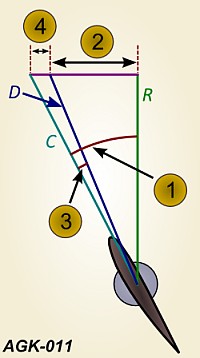
See figure (AGK-011) The angle indicated by arrow number 1 shows the propeller's... D: Direction of air flow C: Chord line R: Direction of rotation
Show solution
The correct answer is 'angle of incidence.' This is the angle between the propeller blade's chord line and the plane of rotation. The other options are incorrect: 'angle of attack' is between chord line and airflow, and 'wing twists' refer to blade shape, not this angle.
What should be considered regarding a scheduled flight over water, when land cannot be reached in case of an emergency landing?
Show solution
For flights over water where land cannot be reached in an emergency, life jackets or lifeboats must be available for all passengers. The other options are incorrect as they are not mandatory or relate to different emergencies.
How can the pilot of an an engine-driven aircraft minimise the noise emission during descent and approach?
Show solution
A high approach with minimum power, late descent, late configuration, and adherence to established arrival routes minimizes noise, as it avoids unnecessary engine use and low overflights. The other options increase noise due to longer, lower, or earlier configured approaches.
When should turns at low altitudes above villages be avoided with regard to noise abatement procedures?
Show solution
Turns in climb should be avoided over villages because the aircraft is loudest at high power and steep angle. In descent, horizontal flight, or during approach, engine power is usually lower, so noise is less of a problem.
How should departures near villages be carried out?
Show solution
Villages should be circumnavigated or crossed at a sufficient altitude to avoid noise and risk. Flying low and fast, or slow with low propeller speed, or slow climbs and turns near villages is not appropriate or safe.