Private Pilot Licence - Aeroplane
Demo: PPL/A
Real exam questions to try for free — no registration needed.
Why is it dangerous to pump the throttle for engine start in cold weather?
Show solution
Pumping the throttle can let unburned fuel enter the intake, which may ignite and cause a carburettor fire. The other options do not describe the main risk of this action during engine start.
Which danger exists during engine start?
Show solution
The correct answer is 'Carburettor fire', as fuel in the carburettor can ignite during engine start. Sparking, cable fire, and smoke emission are less typical dangers at this stage.
May an engine, which previously was on fire, be restarted?
Show solution
An engine that has been on fire must not be restarted because the risk of reignition is too high. The other answers are incorrect: safe altitude, taxiing, or carburettor fire do not eliminate the main danger after an engine fire.
Smoke enters the cockpit during an engine fire. Which actions have to be taken immediately?
Show solution
Switching off the heating and ventilating system is correct, as these can bring smoke into the cockpit. The other actions do not stop smoke entry or are not immediately relevant in this situation.
What should be the first action in case of a cable fire during a flight?
Show solution
Turning off the master switch cuts the electrical power, stopping the source of the fire. Closing the fuel valve, opening windows, or cabin ventilation do not address the electrical fire directly.
In flight, a little smoke emerges from behind the instrument panel. An electrical fire is suspected. Which action, with respect to the pilot's operating manual, should be taken?
Show solution
Turning off the master switch immediately cuts electrical power, stopping the source of an electrical fire. Turning off the heat, shutting down the engine, or using the fire extinguisher do not directly remove the electrical source and are not the first step.
In flight, a little smoke emerges from behind the instrument panel. An engine fire is suspected. Which action, with respect to the pilot's operating manual, should be taken?
Show solution
Turning off the heat stops smoke or fumes from entering the cabin from the engine compartment. The other actions are not the first recommended step, as they do not immediately prevent smoke from entering or directly address the hazard.
A wind shear is...
Show solution
The correct answer is: a vertical or horizontal change of wind speed and wind direction. Wind shear means sudden changes in wind speed or direction. The other options describe specific phenomena, slow changes, or require a certain speed change, which is not accurate.
Which weather phenomenon is typically associated with wind shear?
Show solution
Thunderstorms are often linked to strong wind shear, both horizontal and vertical, due to intense updrafts, downdrafts, and sudden changes in wind direction and speed. The other weather phenomena usually do not cause significant wind shear.
When do you expect wind shear?
Show solution
Wind shear often occurs in the presence of an inversion, as wind speed and direction can change rapidly with height. Passing a warm front, calm wind in cold weather, or summer days with calm winds are less likely to cause wind shear.
During an approach the aeroplane experiences a windshear with a decreasing headwind. If the pilot does not make any corrections, how do the approach path and the indicated airspeed (IAS) change?
Show solution
With decreasing headwind, IAS drops and lift decreases, causing the approach path to become lower and IAS to decrease. The other answers are incorrect because they suggest either an increase in IAS or a higher path, which does not happen in this scenario.
During an approach the aeroplane experiences a windshear with an increasing headwind. If the pilot does not make any corrections, how do the approach path and the indicated airspeed (IAS) change?
Show solution
With increasing headwind, lift increases, so the aircraft climbs above the approach path and IAS increases. The other answers are wrong because they suggest a lower path or decreasing IAS, which does not happen with increasing headwind.
During an approach the aeroplane experiences a windshear with a decreasing tailwind. If the pilot does not make any corrections, how do the approach path and the indicated airspeed (IAS) change?
Show solution
With decreasing tailwind, the headwind component increases. This causes IAS to increase and the aircraft to rise above the approach path. So: Path is higher, IAS increases. The other answers are incorrect because they suggest a lower path or decreasing IAS, which is not correct in this scenario.
After take-off an aeroplane gets into a wind shear with decreasing headwind. As a result...
Show solution
With decreasing headwind, true airspeed (TAS) drops and lift decreases, so the aeroplane flies below the estimated climb path. The other answers are wrong: TAS does not increase, GS does not decrease, and the aircraft does not fly above the climb path.
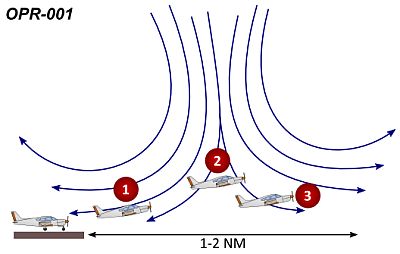
Which phenomenon may be expected at point 2 of the microburst? See figure (OPR-001)
Show solution
At point 2 of the microburst, the aircraft encounters descending air. This reduces the climb rate, as the aircraft must fight against the downdraft. The other answers are incorrect because airspeed does not increase and the descent rate does not decrease or stay constant.
Which phenomenon may be expected at point 3 of the miroburst? See figure (OPR-001)
Show solution
At point 3 of the microburst, the aircraft encounters a tailwind, causing a decrease in airspeed. The other options are incorrect because a tailwind reduces, not increases, airspeed and does not directly affect the rate of climb or descent.
How can a wind shear encounter in flight be avoided?
Show solution
The correct answer is to avoid take-off and landing during heavy showers or thunderstorms, as wind shear is often associated with these conditions. The other options mention weather phenomena but are not specifically relevant to wind shear.
Immediately after lift-off, a microburst is entered inadvertently. Which action might avoid an unintentional descent?
Show solution
The correct action is to set maximum power, maintain present configuration, and climb at best rate of climb speed. This maximizes lift and climb performance. The other options involve configuration changes or turns, which can increase the risk of further descent.
Wake turbulences develop during take-off just as the aeroplane...
Show solution
Wake turbulence starts as soon as the aircraft lifts off with the front gear, because this is when lift is first generated by the wings. It does not start just by accelerating or reaching a certain altitude. Lifting off with the main gear is too late.
Wake turbulence is particularly strong...
Show solution
Wake turbulence is strongest when flying at low speeds because lift is greatest and wingtip vortices are most intense. At high speeds or altitudes, less lift is needed, so wake turbulence is weaker.
With only a slight crosswind, what is the danger at take-off after the departure of a heavy aeroplane?
Show solution
Correct: Wake turbulence on or near the runway. With only slight crosswind, wake turbulence drifts slowly and can remain close to the runway, posing a hazard. The other options describe effects that occur with stronger winds or are incorrect for light crosswind.
A technical fault requires an emergency off-field landing. Which steps, with respect to the pilot's operating handbook, are necessary?
Show solution
The correct order is: locate a landing area, plan the approach, complete the emergency procedure, declare an emergency, and focus on the approach. Other options miss key steps or are not practical for real emergencies.
An emergency landing is a landing...
Show solution
Correct: An emergency landing is always conducted in response to circumstances forcing the aircraft to land. The other options are incorrect because an emergency landing is not always without engine power, with flaps retracted, or just for safety reasons.
A landing conducted in response to circumstances forcing the aircraft to land is a / an...
Show solution
The correct answer is 'emergency landing' because it means a landing forced by danger or technical failure. 'Precautionary landing' is planned for safety, 'urgent landing' is not an official term, and 'field or out landing' refers only to landings outside airfields, not necessarily forced.
A precautionary landing is a landing...
Show solution
Correct: conducted in an attempt to sustain flight safety. A precautionary landing is made to avoid potential danger. The other options refer to forced landings, engine failure, or technical details not specific to precautionary landings.