Private Pilot Licence - Aeroplane
Demo: PPL/A
Real exam questions to try for free — no registration needed.
How does the pilot prepare for a VFR flight over a large distance of water, when it is unlikely that land can be reached in case of an engine failure?
Show solution
For VFR flights over water where land cannot be reached after engine failure, life vests or a life raft for all occupants are required. The other options are not mandatory or relate to different safety aspects.
In case of an emergency ditching, the life vests have to be inflated...
Show solution
Life vests should be inflated after leaving the aircraft, because inflating them inside can hinder evacuation or block exits. Inflating before or during exit can cause problems. After leaving, it is safe to inflate the vest.
What are the effects of wet grass on the take-off and landing distance?
Show solution
Wet grass increases rolling resistance during take-off and reduces braking during landing. This means both take-off and landing distances increase. The other answers are incorrect because they suggest a decrease or only one distance increasing.
Under which circumstances may a runway be considered to be "contaminated"?
Show solution
A runway is considered contaminated when more than 25% of its surface within the required length and width is covered by water, slush, snow, or ice more than 3 mm deep. The other options use higher percentages or different substances, which do not match the official definition.
Wet snow on a runway can lead to...
Show solution
Wet snow on a runway increases rolling resistance because the aircraft needs more force to move through the heavy, wet snow. The other options are incorrect: wet snow does not reduce resistance, does not cause carburetor icing, and does not directly affect lift.
Which danger exists after a heavy rain shower for a landing aircraft?
Show solution
After heavy rain, water can accumulate on the runway, causing aquaplaning. The tires lose contact with the surface, so braking is less effective and the stopping distance increases. The other options are incorrect or unrelated to aquaplaning.
During a flight with a flight plan submitted, landing is conducted at an airfield other than the destination stated in the filed flight plan. Who has to be contacted by the pilot immediately?
Show solution
The Aeronautical Information Service (AIS) must be contacted, as it manages and monitors flight plans. The police, flight manager, or local supervision office are not responsible for this notification.
Exceeding the maximum allowed aircraft mass...
Show solution
Exceeding the maximum allowed aircraft mass is not permissible and is essentially dangerous, as it seriously affects performance and safety. The other options are incorrect because they suggest exceptions or compensation, which are not allowed by regulations.
The basic empty mass of an aircraft includes...
Show solution
The basic empty mass includes the mass of the aircraft, all fixed ballast, unusable fuel, undrainable oil, engine coolant, and hydraulic fluid. It does not include crew, baggage, or usable fuel.
The term "center of gravity" is defined as...
Show solution
The center of gravity is the point at which the total mass of the aircraft is considered to act. The other options are incorrect: it's not just the heaviest point, not the neutral point, and not halfway between the neutral point and datum line.
The term "moment" with regard to a mass and balance calculation is referred to as...
Show solution
The moment is the product of a mass and a balance arm. Only this gives the turning effect about a point. The sum, difference, or quotient of mass and arm do not represent a physical moment.
The balance arm is the horizontal distance between...
Show solution
The balance arm is the horizontal distance between the C.G. of a mass and the datum line. The other options are incorrect because they refer to limits or compare the C.G. to a limit, not to the datum, which is the reference point.
What is a precondition to calculate the Basic Empty Mass of an aircraft?
Show solution
Before weighing, all useable fuel must be drained so only the Basic Empty Mass is measured. Engine oil, batteries, and service equipment are part of the Basic Empty Mass and should remain in the aircraft.
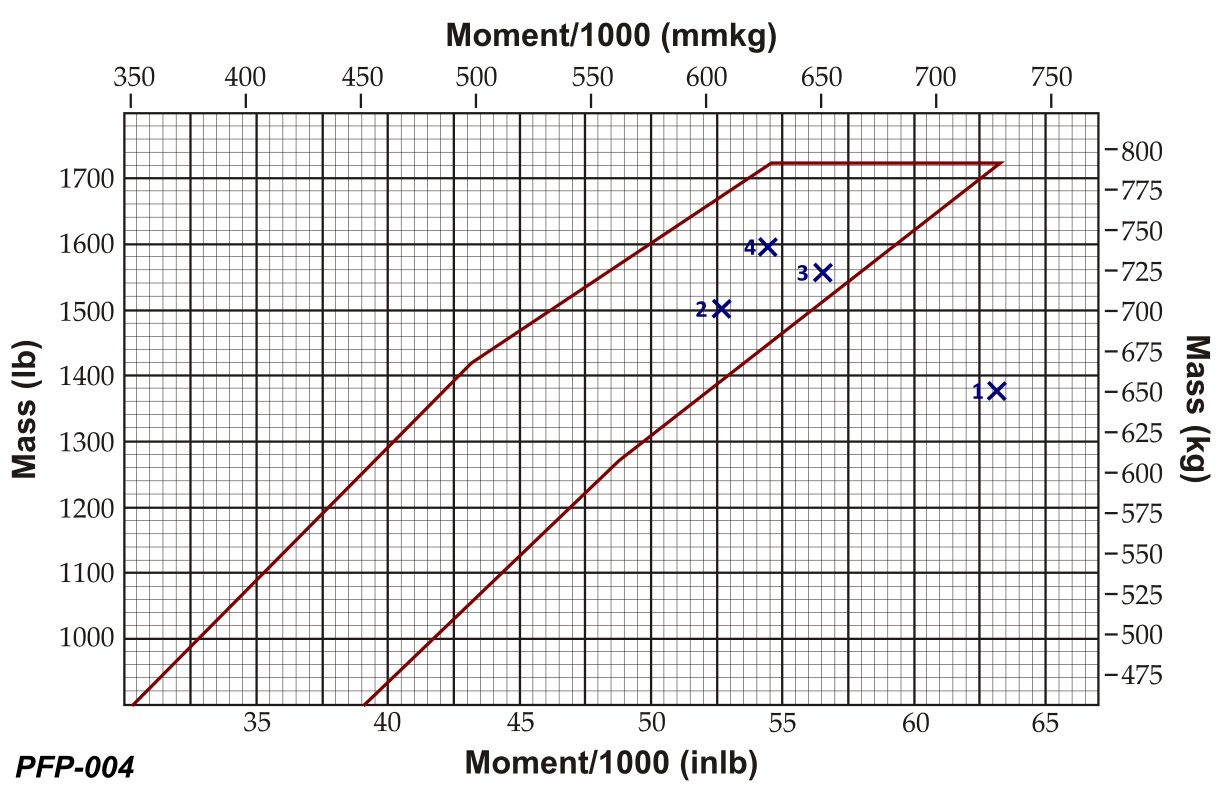
For the purpose of a flight preparation the pilot calculates a total take-off mass of 725 kg and a total moment of 650 mmkg. Which cross marks the center of gravity (CG)? See annex (PFP-004)
Show solution
The correct cross is at the intersection of 725 kg (mass) and 650,000 mmkg (moment). Only this cross shows the correct center of gravity. The other crosses are at different mass or moment values and are therefore incorrect.
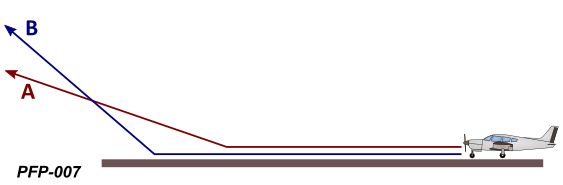
How does the aircraft configuration influence take-off performance while all other parameters remaining constant? See figure (PFP-007)
Show solution
Aircraft A has a higher flap setting than aircraft B. A higher flap setting increases lift during take-off. The other answers are incorrect because they refer to a lower flap setting or tyre pressure differences, which are not relevant in this context.
How does aircraft flap configuration influence the take-off performance?
Show solution
With take-off flaps, ground roll and lift-off speed decrease due to increased lift, but climb performance decreases because of higher drag. The other answers are incorrect as they wrongly state climb performance increases or misstate speed/distance effects.
Which factor shortens landing distance?
Show solution
A strong head wind shortens landing distance by reducing groundspeed at touchdown. High density altitude, high pressure altitude, and heavy rain all increase landing distance by reducing braking effectiveness or aircraft performance.
The angle of descent is defined as...
Show solution
Correct: The angle of descent is the angle between a horizontal plane and the actual flight path, expressed in degrees. The other answers confuse angles with percentages or describe a ratio, not the angle itself.
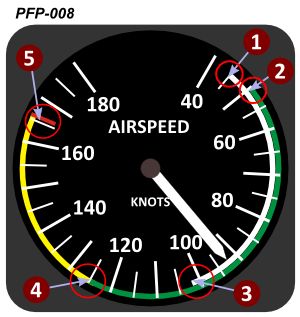
The beginning of the green arc (2) indicates which airspeed? See figure (PFP-008)
Show solution
The beginning of the green arc indicates the stall speed with flaps up (VS1). The other options are incorrect: one refers to stall speed in landing configuration (VS0), another to maximum flap speed (VFE), and one to maximum normal operating speed (VNO).
For a take-off from runway 22 and a reported wind of 250°/10 kt, the longitudinal wind component equals...
Show solution
The correct answer is '9 kt headwind' because the wind is almost directly ahead (only 30° off the runway heading). The longitudinal component is cos(30°) × 10 kt ≈ 9 kt. The other answers are incorrect as they either have the wrong direction or value.
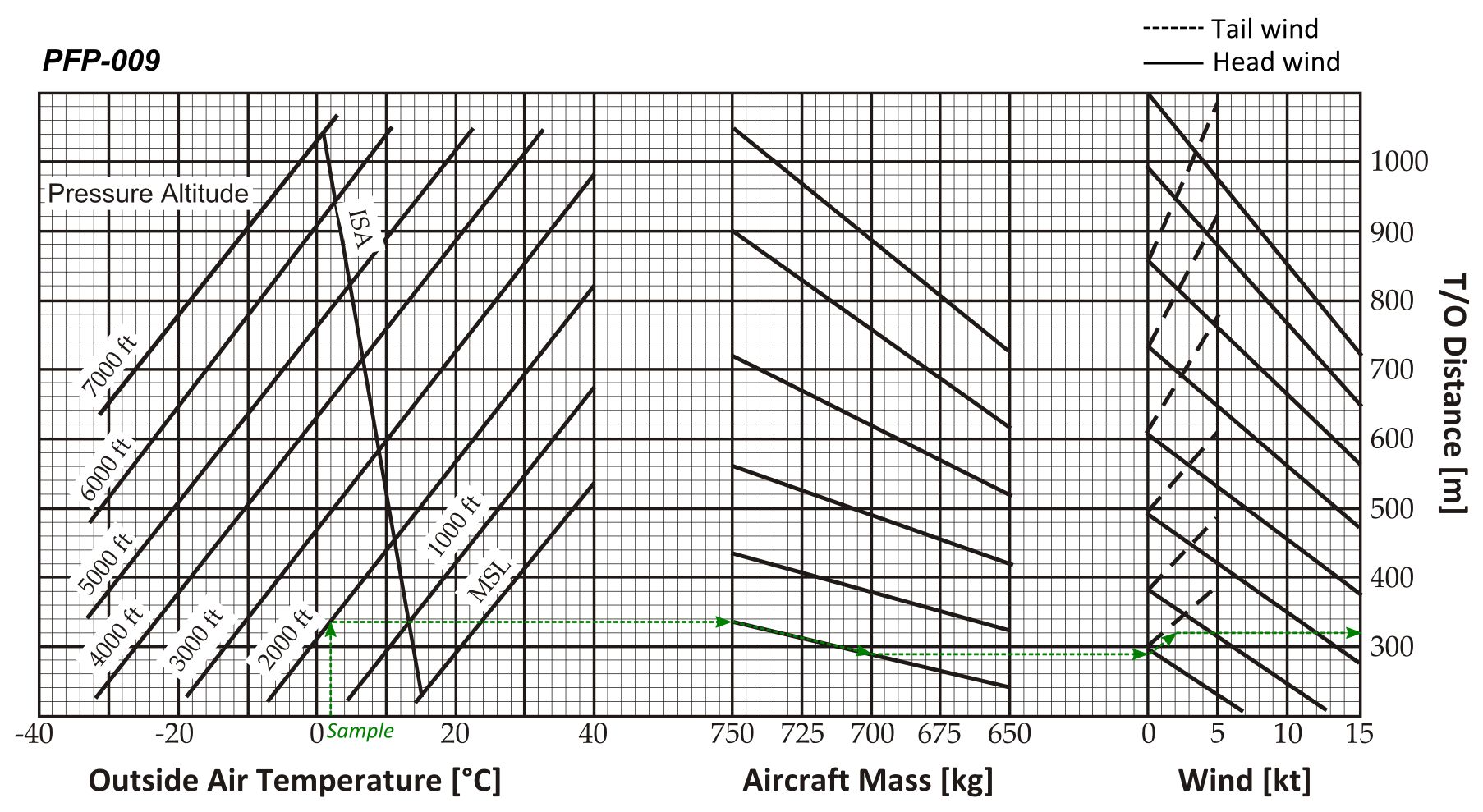
Given the following conditions, the take-off distance equals... Outside air temperature: -20° C Pressure Altitude: 5000 ft Aeroplane mass: 750 kg Headwind: 10 kt See annex (PFP-009)
Show solution
The correct answer is 380 m. Low temperature, high pressure altitude, low mass, and 10 kt headwind result in a short take-off distance. 410 m, 310 m, and 450 m are either too long or too short for these conditions.
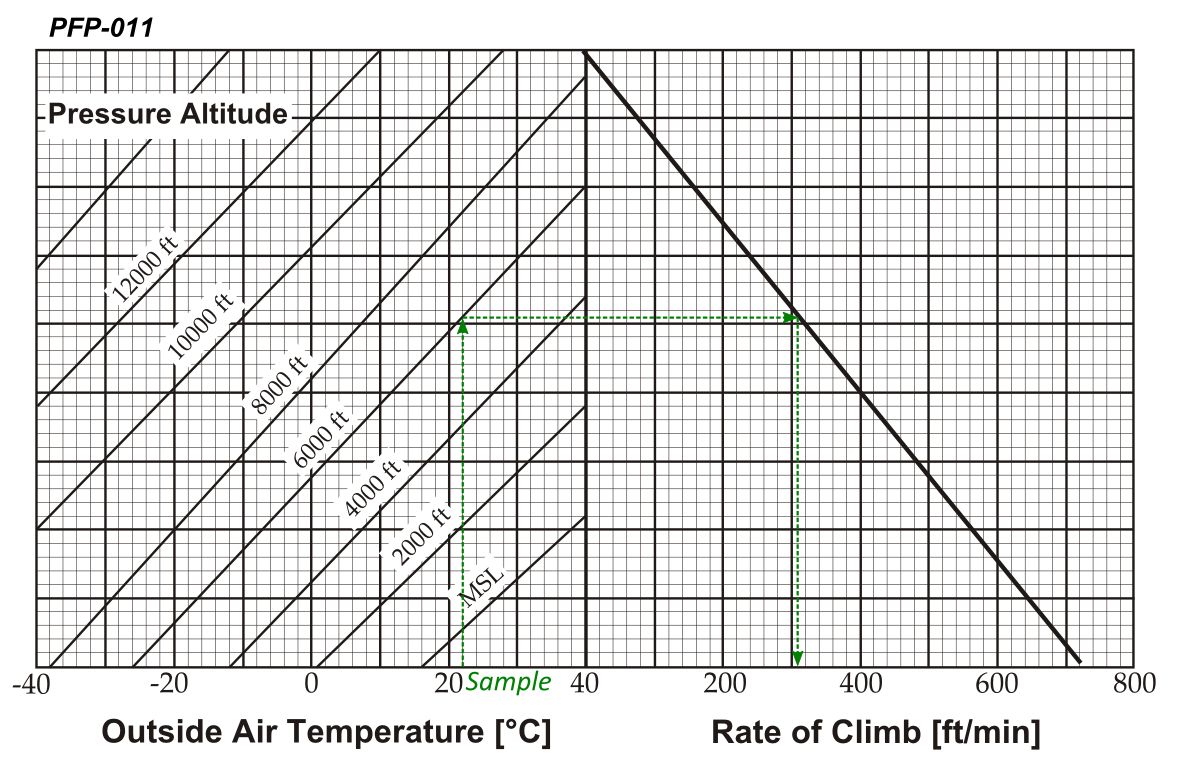
Given the following conditions, the rate of climb equals... Outside air temperature: -20° C Pressure altitude: 10000 ft See annex (PFP-011)
Show solution
The correct answer is 390 ft/min, as at -20°C and 10,000 ft, the climb rate chart shows this value. 200 ft/min, 350 ft/min, and 450 ft/min are incorrect because they are either too low or too high for these conditions.
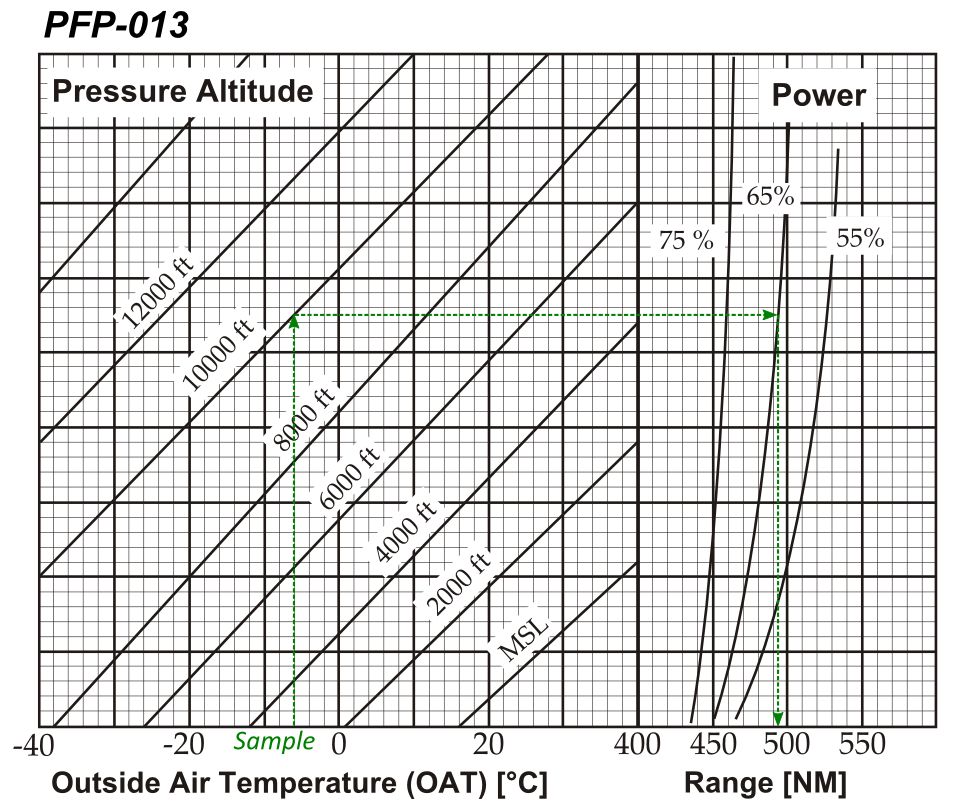
What range can be achieved at the following conditions? Outside air temperature: 6° C Pressure Altitude: 6000 ft Power: 65 % See annex (PFP-013)
Show solution
The correct answer is 482 NM, as performance data shows this range at 6°C, 6,000 ft, and 65% power. The other options (503 NM, 457 NM, 444 NM) do not match these conditions and are therefore incorrect.
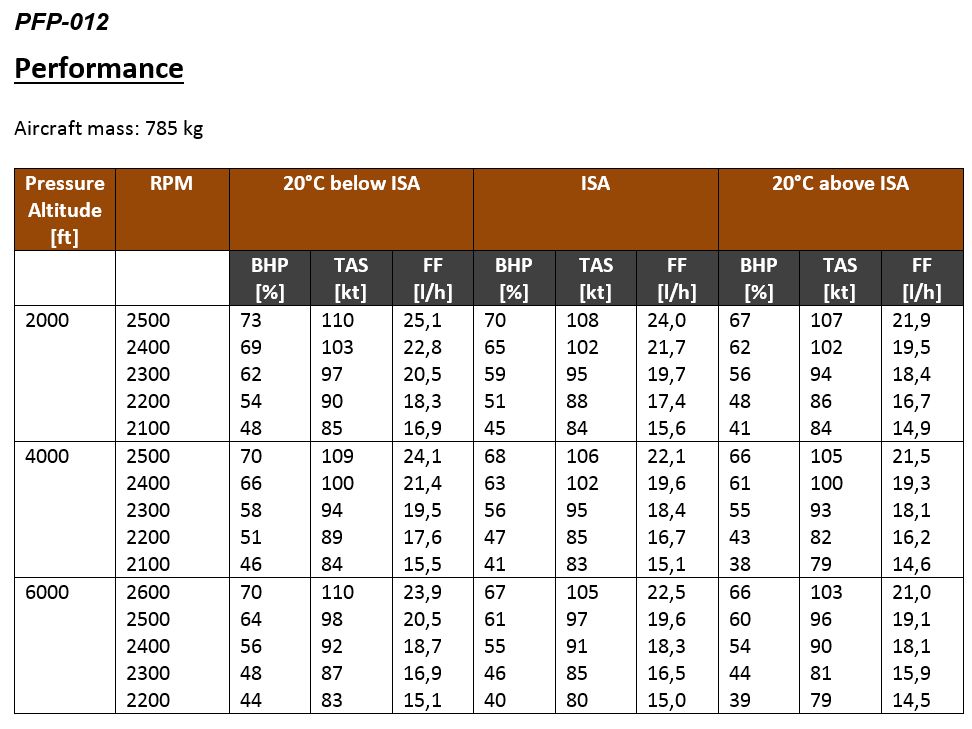
What is the true airspeed (TAS) [kt] and fuel consumption [l/h] for cruise flight with 70 % power in flight level 60 under the following conditions? Temperature: ISA - 20° C QNH: 980 hPa See annex (PFP-012)
Show solution
The correct answer is 110 kt and 23.9 l/h, as at 70% power in FL60 and ISA-20°C, the TAS and fuel consumption are highest according to performance data. The other values are too low for this power setting and altitude.
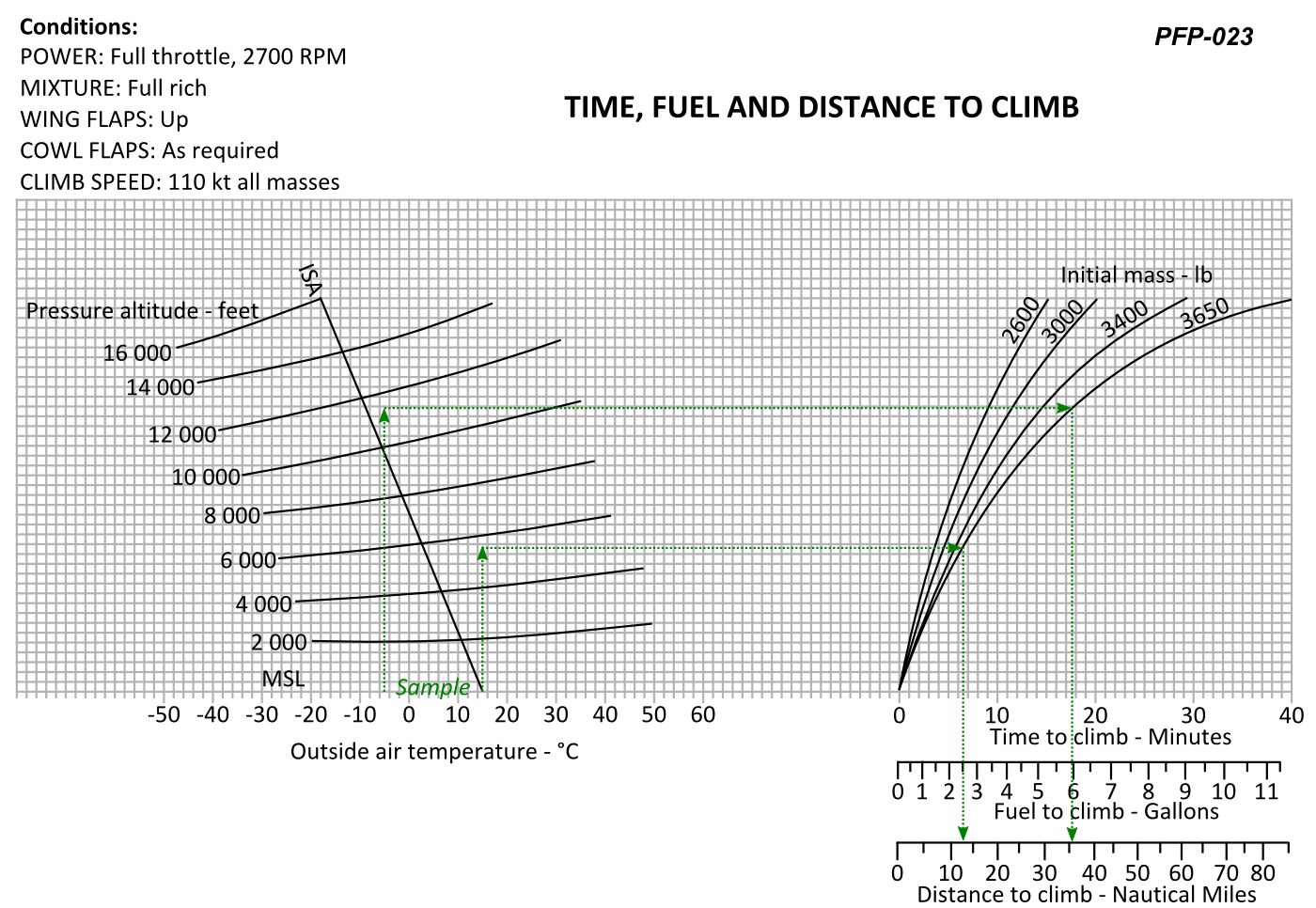
What is the required distance to climb to flight level (FL) 75 after a departure from an airfield which is located at a pressure altitude of 3000 ft with an initial mass of 3000 lbs? OAT at airfield: 25° C OAT in FL 75: 0° C See annex (PFP-023)
Show solution
The correct answer is 7 NM, as the climb chart shows this distance is needed to reach FL 75 with the given mass, pressure altitude, and temperatures. 12 NM and 17 NM are too long, 5 NM is too short for these conditions.