Private Pilot Licence - Aeroplane
Demo: PPL/A
Real exam questions to try for free — no registration needed.
The load factor "n" describes the relationship between...
Show solution
The load factor 'n' is the ratio of lift to weight. It shows how much greater the lift is compared to the weight. The other options are incorrect because they compare forces not relevant to the load factor.
Which are the advantages of sandwich structures?
Show solution
Sandwich structures offer low weight, high stiffness, high stability, and high strength because they combine lightweight cores with strong outer layers. The other options mention temperature durability or formability, which are not main features of sandwich structures.
Which of the stated materials shows the highest strength?
Show solution
Carbon fiber reinforced plastic has the highest strength due to its excellent tensile and bending properties. Wood, aluminium, and magnesium are less strong and are used where low weight or other features are more important.
Reasons for dents in the aircraft structure are...
Show solution
Dents in the aircraft structure are usually caused by hard landings or excessive stress, as these apply strong forces to the structure. Material defects, old paint, erosion, wear, or engine issues do not typically cause dents.
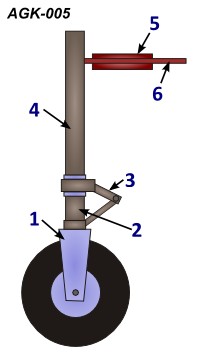
Number 1 on the gear designates the... See figure (AGK-005)
Show solution
The fork connects the strut to the wheel and allows steering movement. It is the part marked as number 1 in the figure. The other options are incorrect as they refer to different landing gear components.
The fuselage structure may be damaged by...
Show solution
Exceeding the manoeuvering speed in heavy gusts can damage the fuselage structure, as it may cause loads beyond design limits. The other options relate to aerodynamic effects or control behavior, not structural strength.
How is the nose or tail wheel usually controlled on small aircraft and motor gliders?
Show solution
The nose or tail wheel is usually controlled by the pedals in small aircraft and motor gliders, as they are directly linked to the wheel. The control column, steering wheel, or weight movement do not control the wheel.
What kind of control surface is connected with the nose wheel?
Show solution
The rudder is connected to the nose wheel steering, as both control the aircraft's direction on the ground. Aileron, elevator, and trim rudder control other axes or fine adjustments, not ground steering.
About how many axes does an aircraft move and what are these axes called?
Show solution
An aircraft moves about three axes: vertical, lateral, and longitudinal. These allow yaw, pitch, and roll. Options with two or four axes are incorrect, as only three exist. Terms like 'axis of speed' or 'axis of evil' are not correct for aircraft movement.
A movement around the longitudinal axis is primarily initiated by the...
Show solution
Ailerons control movement around the longitudinal axis (roll). The rudder controls the yaw axis, the elevator controls the pitch axis, and the trim tab only reduces control forces.
What is the effect of pulling the control yoke or stick backwards?
Show solution
Pulling the yoke increases the tail's downward force, making the nose rise. The other answers are wrong because they either say the nose drops or mention upward force at the tail, which is incorrect.
What is the purpose of the secondary flight controls?
Show solution
Secondary flight controls improve aircraft performance and reduce the pilot's control forces. They do not directly control movement about the three axes, do not directly manage flight path or speed, and are not a backup for primary controls.
The trim wheel or lever in the cockpit is moved aft by the pilot. What effect does this action have on the trim tab and on the elevator?
Show solution
Moving the trim wheel aft causes the trim tab to move down, making the elevator move up, which raises the aircraft's nose. The other answers are incorrect because they mix up the directions of the trim tab and elevator movement.
When trimming an aircraft nose up, in which direction does the trim tab move?
Show solution
The trim tab moves down to push the elevator up, causing the aircraft to trim nose up. The other answers are incorrect: the trim tab does not move up, it does not depend on CG position, and it does not follow rudder deflection.
What must be considered during refueling?
Show solution
Correct: No open fires, obey smoking ban and apply ground cables. This prevents sparks and fire hazards. The other options are wrong because they suggest unsafe actions or ignore essential safety steps.
What is the purpose of the tank ventilation?
Show solution
Tank ventilation prevents underpressure in the tank as fuel is consumed. Without it, fuel flow to the engine could be interrupted. The other options do not describe the real purpose of tank ventilation.
An aircraft's electrical power supply is carried out by the: 1. Battery 2. Generator 3. Relay 4. Circuit breaker
Show solution
Electrical power is supplied by the battery and generator. Relays and circuit breakers only control or protect the system, but do not supply power. Therefore, only battery and generator is correct.
What is the unit for electrical power?
Show solution
The correct answer is Watt, as electrical power is measured in watts. Ohm measures resistance, Volt measures voltage, and Ampere measures current. Only Watt is the unit for power.
What is the reason for static dischargers on aircraft?
Show solution
Static dischargers discharge static electricity that builds up during flight. This prevents sparks and interference. The other options are incorrect: they do not ensure grounding during refueling, improve radio quality at altitude, or eliminate radio traffic interference.
What devices can be affected by a failure of the electrical system?
Show solution
Radio, navigation, and gyro instruments rely on electrical power. The magnetic compass, airspeed indicator, and altimeter work without electricity. Fuel gauges can be electric, but the artificial horizon is usually a gyro instrument.
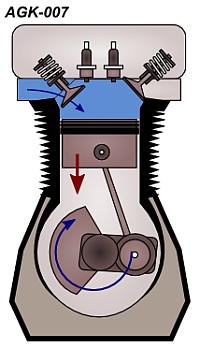
Which part of the cycle of a four-stroke Otto engine can be seen in the attachment? See figure (AGK-007)
Show solution
Correct is 'First stroke - induction' because the intake valve is open and the mixture enters the cylinder. The other options are wrong: during compression, power, or exhaust, the intake valve is not open and the piston moves differently.
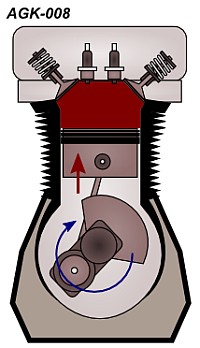
Which part of the cycle of a four-stroke Otto engine can be seen in the attachment? See figure (AGK-008)
Show solution
The correct answer is 'Second stroke - compression' because during compression, the piston moves up and compresses the mixture. 'Induction' has the piston moving down, 'power' follows ignition, and 'exhaust' opens the exhaust valve.
What is the likely cause if the engine runs unusually rough while checking the magnetos?
Show solution
A defective sparking plug can cause the engine to run rough during the magneto check because it fails to ignite the mixture properly. The other options involve parts that do not directly affect engine running during this check.
Where does the condensation water converge in the tank?
Show solution
Condensation water collects at the lowest position in the tank because water is heavier than fuel and sinks. It does not float on the fuel, is not permanently mixed, and does not gather near the tank cap.
Which colour does Avgas 100 LL have?
Show solution
Avgas 100LL is blue to distinguish it from other aviation fuels. Green is for Avgas 100, Red for Avgas 80, and Yellow is not used for aviation gasoline.